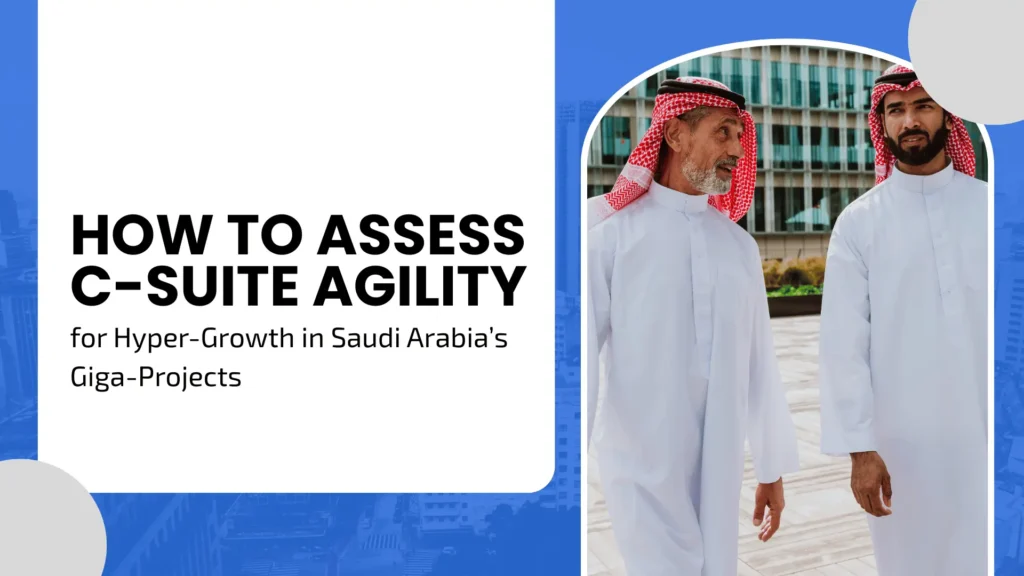
Let’s be real for a second. When you hear the words “Saudi Arabia’s giga-projects” (think NEOM, the Red Sea Project, or Qiddiya), your brain probably jumps to flying cars, robotic workers, and a skyline that looks like a sci-fi movie set.
But for those of us actually doing the workwhether you are an Arab American executive weighing a move back to the region, or a US employer trying to figure out setting up a team in saudi arabiathe real magic isn’t just the architecture. It’s the leadership.
Hyper-growth in the Gulf isn’t for the faint of heart. You can’t manage a $500 billion project with a traditional “slow and steady” corporate mindset. You need C-suite agility. But how do you assess that in an interview? How do you know if your next VP of Operations can pivot from a supply chain crisis in Jeddah to a stakeholder dinner in Dubai without missing a beat?
Let’s break down how to spot that agility, why the gcc business climate demands it, and how both US companies and Gulf employers can get this right.
Why “Safe” Leaders Fail in Saudi Giga-Projects
I’ve seen it happen more times than I can count. A brilliant executive from a Fortune 500 company lands in Riyadh to lead a neom project jobs initiative. On paper, they are perfect. But within six months, they are burning out.
Why? Because they couldn’t handle the uncertainty. In hyper-growth environments, the rulebook is being written while the plane is in the air.
In Saudi Arabia, specifically under Saudi Vision 2030 jobs for foreigners, the pace is staggering. What takes five years in London or New York might take five months in hiring in riyadh right now. If a C-suite candidate needs perfect data, zero ambiguity, and a nine-month strategic planning cycle before they move, they will drown.
Agility here means: Comfort with calculated chaos. It means making a 70% decision today rather than waiting for 100% certainty next quarter.
The Cultural Agility Factor: Beyond “Cross-Cultural Training”
Most US employers think that hiring a bilingual Arab American professional solves the culture gap automatically. It doesn’t. Knowing the language isn’t the same as knowing the rhythm of business in the Gulf.
When you are assessing a leader for a Saudi giga-project, you need to look for “relational agility.” In the West, we tend to move fast and break things. In the GCC, relationships are the infrastructure.
I remember placing a VP of Construction for a major megaprojects jobs contract. He was a brilliant engineer from Chicago. But his agility came from how he handled a permit delay. Instead of sending an angry email, he drove to the government office, sat down for tea for 45 minutes, and solved the issue in ten minutes of actual talking.
That is agility. When assessing candidates, ask: “Tell me about a time you had to switch from a direct, task-oriented style to a consultative, relationship-first approach to save a deadline.”
If they look confused, they aren’t ready for business expansion in gcc market comparison realities.
The Visa & Mobility Stress Test
Here is a practical tip most recruiters skip. To test a C-suite candidate’s agility, ask them about logistics.
Hyper-growth projects don’t wait for paperwork. If you are hiring a Chief Operating Officer to oversee neom careers 2024, they need to understand the grind of mobility. Do they know the difference between a saudi arabia work visa and a business visit visa? Do they understand how onboarding expatriates in middle east differs from onboarding in Texas?
A truly agile executive doesn’t just complain about the bureaucracy; they have a mental roadmap for navigating it. They know that relocation support middle east isn’t a perk; it’s a project requirement. If your leadership team doesn’t understand the urgency behind getting boots on the ground, your giga-project stalls before it starts.
Red Flags vs. Green Flags in the Interview
When you are sitting across from a candidate (virtually or in person), look for these signals.
Green Flag (Agile): They talk about iterative delivery. They say things like, “We can launch phase one with 80% of the resources and optimize phase two based on what we learn.” They ask specific questions about supply chains in the Gulf and family support uae for their team (which shows long-term thinking).
Red Flag (Brittle): They ask for a detailed five-year roadmap before signing. They complain about the dubai expat salary guide compared to their last US role. They worry more about their corner office size than about how to attract arab tech professionals usa jobs to relocate to Riyadh. Avoid the divas. You need builders.
The American Factor: Leveraging the Dual Perspective
For Arab American professionals, you have a secret weapon. You understand the speed and accountability of the US market, but you likely have the cultural intuition of the Arab world. That is gold.
Companies doing us arab joint venture project management are desperate for leaders who can bridge that gap. You speak the language of ROI and quarterly earnings, but you also understand wasta (not as corruption, but as social capital) and the importance of Friday family dinners.
If you are an executive looking at careers in middle east for westerners, don’t hide your US experience. Lead with it. But prove your agility by showing you have done the homework on qatar recruitment laws or the specific nuances of a dubai free zone setup versus operating in mainland KSA.
Why a Dedicated Partner Changes the Game
Navigating this landscape alone is tough. Whether you are a US tech firm trying to hire a CTO for a smart city project, or a Saudi holding company looking for a CFO who understands US GAAP and Saudi ZATCA compliance, you need specialists.
Firms like Arab American Recruiters specialize exactly in this cross-pollination. They understand the nuances of usa tech relocation for senior leaders just as well as they understand the draw of renewable energy jobs saudi arabia. They handle the messy middlethe saudi arabia work visa hurdles, the expat retention dubai strategies, and the cross-cultural training that turns a good hire into a legacy leader.
When you are moving at hyper-growth speed, you don’t have time to learn the qatar recruitment laws from scratch. You need a partner who already has the playbook.
The Resilience Loop: Retaining Agile Leaders
Assessing agility is one thing. Keeping it is another. The biggest threat to gcc economic diversification right now isn’t a lack of money; it’s burnout.
Agile leaders usually run hot. They sprint. But giga-projects are marathons disguised as sprints.
To retain top talent on neom project jobs or fintech careers dubai, you need to build a support system. This means:
- Family integration: If you don’t offer family support uae (schooling, spousal work opportunities, community building), your executive will leave within 18 months. Full stop.
- Mental health resourcing: The pressure of a 24/7 support team structure across time zones is brutal.
- Clear mobility paths: Don’t make your American VP guess about their h1b visa for software engineers or their eventual path back to the US if they want it.
Industry FAQ: Your Burning Questions Answered
Q: How can businesses set up a team in Saudi Arabia or Dubai?
A: It depends on your speed. For Dubai, many start with a dubai free zone setup (like DIFC for finance or Dubai Internet City for tech) which offers 100% foreign ownership and simplified visas. For Saudi, setting up a team in saudi arabia usually requires a local partner (or a new regional HQ license if you are a global giant) plus a saudi arabia work visa for each expat. My advice? Hire your local HR or compliance lead firstthey will save you months of headaches.
Q: What are the requirements for Arab professionals to work in the US or GCC?
A: For the US, it’s typically the h1b visa for software engineers or L-1 transfers for managers, plus specific paths like usmle for arab doctors in healthcare. For the GCC, it’s employer-sponsored residency. If you hold a US passport AND Arab heritage, you have a distinct advantage in the Gulf because you qualify for visa sponsorship for healthcare workers and executive roles more easily than non-Arab westerners, but you still need a local sponsor.
Q: How can expatriates integrate smoothly and stay long term in the Middle East?
A: Don’t live in a bubble. Yes, the american community in uae is lovely, but the expats who last are the ones who learn basic Arabic phrases, understand the local holidays, and invest in genuine cross-cultural training. Also, negotiate relocation support middle east that includes cultural coaching for your spouse. If the family isn’t happy, your expat retention dubai rate drops to zero.
Q: Which sectors offer the strongest opportunities in 2024?
A: Three big ones. First, renewable energy jobs saudi arabia (solar and hydrogen are exploding under Vision 2030). Second, fintech careers dubai (the UAE is a regulatory sandbox heaven). Third, tourism jobs qatar (post-World Cup, they are pivoting to luxury and business travel). For US-based roles, us healthcare jobs for arab medical professionals remain strong, especially if you have your nursing license usa or passed the usmle.
The Bottom Line
Hyper-growth doesn’t care about your resume. It cares about your reflexes. Whether you are an Arab American executive wondering if you should take that call from a recruiter in Riyadh, or a US employer trying to vet a candidate for a multilingual call center setup supporting a new city, remember this: Hire for humility and speed. Skill can be taught. Panic is fatal.
If you are ready to stop guessing and start hiring leaders who can actually handle the heat of the Saudi desert and the pace of Dubai, go where the experts are.
Ready to find your next agile leader? Visit Arab American Recruiters to see how we bridge the gap between US talent and GCC hyper-growth.