Let’s be real for a second. You’ve been in that meeting.
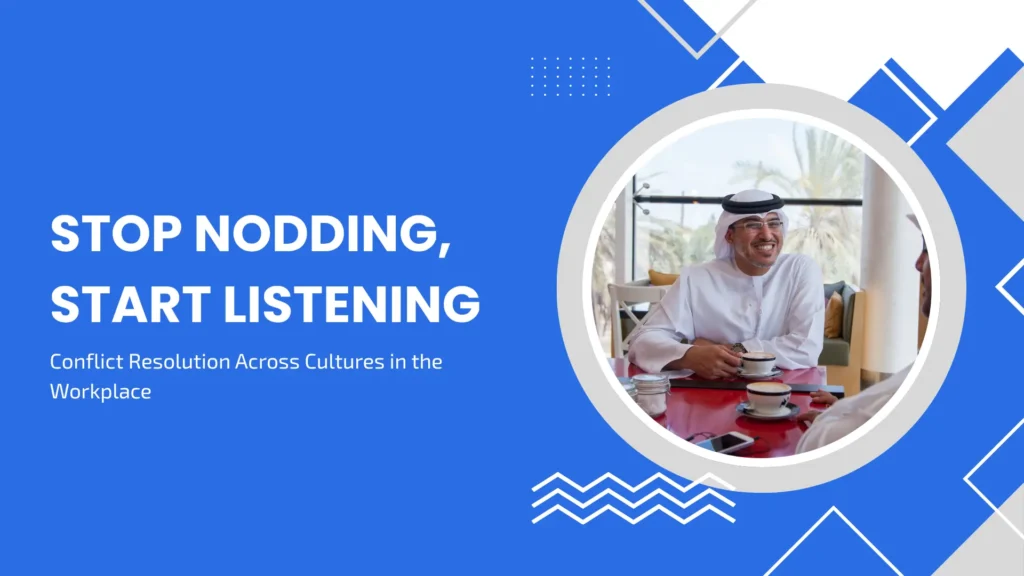
The American manager says, “Let’s put a pin in that and circle back.” The Saudi engineer nods politely. The Emirati finance lead stays silent. Later, you find out the engineer felt dismissed, the finance lead was offended by the lack of relationship building, and the manager has no idea why the project is stalling.
Welcome to the beautiful, messy reality of cross-cultural communication in business.
When you mix the direct, time-is-money culture of the US with the relationship-first, high-context cultures of the Gulf, conflict isn’t a possibilityit’s a guarantee. But here’s the secret: conflict isn’t the enemy. Unmanaged cross-cultural conflict is.
Whether you are an Arab professional navigating the US corporate ladder, a US employer setting up a team in Saudi Arabia, or a GCC company eyeing business expansion in GCC market comparison strategies, you need a new playbook. Not for winning arguments, but for building bridges.
Let’s fix how you fight.
Why “Getting to the Point” Feels Aggressive (And Why “Saving Face” Feels Evasive)
To resolve conflict across cultures, you have to understand the operating system of the person across the table.
The US style (Low-Context):
- Time is linear. Get to the point.
- “No” means no. Silence means disagreement.
- Conflict is professional, not personal.
The Arab/GCC style (High-Context):
- Time is fluid. The relationship comes before the transaction.
- “No” is rarely said directly to preserve honor and dignity (face).
- Silence often means “I’m thinking,” or “I’m too polite to tell you you’re wrong.”
When an American hears an Arab colleague say, “We will try our best,” the American hears “Yes.” The Arab colleague likely meant, “That is highly unlikely, but I don’t want to embarrass you.”
See the problem?
For US Employers: You Can’t Manage Riyadh Like You Manage Chicago
You just landed a contract for neom project jobs, or you’re finalizing your ksa recruitment strategy. Great. But if you try to resolve disputes via a 15-minute Zoom lecture, you will fail.
Here is your practical guide to conflict resolution when hiring in Riyadh or navigating the uae talent pool.
1. The “Wasta” Conversation (Don’t Panic)
You might hear about wasta (using connections to get things done). In Western eyes, this looks like favoritism. In the GCC context, it’s often about trust and social capital. If a conflict arises because a local hire was chosen over an expat, don’t call HR for a policy review. Call a meeting to discuss team cohesion. Acknowledge that trust matters. Then, set clear, transparent KPIs for everyone.
2. Never Publicly Correct a Senior Local Hire
In the US, you pull someone aside. In a dubai free zone setup or a Saudi boardroom, correcting a manager in front of junior staff is a career-limiting move. If a conflict erupts over a missed deadline, handle it in a private majlis-style setting (tea, small talk, then the issue). Public shame shuts down communication immediately.
3. Invest in Cross-Cultural Training Before the Crisis
Most companies buy this after a team explodes. Don’t. If you are handling onboarding expatriates in middle east, add a 2-hour module on “How we say no.” It will save you months of expat retention dubai headaches. When people understand that “I will see” actually means “That’s impossible,” they stop getting angry and start finding solutions.
For GCC Businesses Hiring Westerners: Stop Expecting Mind Readers
If you are a Qatari or Emirati firm bringing in American talent, you are hiring for speed and directness. But then you get frustrated when your US project manager tells a local vendor, “This design is ugly.”
To the American, that’s honesty. To the local vendor, that’s a loss of face.
If you want to succeed with us arab joint venture project management, you need a bilingual customer support center arabic english mindsetnot just for phones, but for feedback.
- Create a “Translation” Layer: Tell your American hires, “Say your critique, but say it starts with ‘The concept is strong, and with one change…’”
- Schedule Separate Feedback Loops: Never mix technical feedback with personal criticism. Americans mix them naturally; Arabs keep them separate.
For Arab American Professionals: You Are the Bridge (Use That Power)
You have a superpower. You know when the American boss is rushing because the quarterly report is due. You know when the Gulf client is stalling because they need to consult the family or senior partner.
Don’t just translate words. Translate intent.
Navigating the US Job Market
For Arab tech pros, the market is hot. Companies looking for arab tech professionals usa jobs aren’t just hiring coders; they need cultural liaisons. When you interview for that h1b visa for software engineers role, don’t just list Python. Say: “I have experience managing remote teams in different time zones between the US and GCC.” That line gets you the job.
Similarly, in us healthcare jobs for arab medical professionals, your ability to handle conflict between a direct US nursing staff and a deferential Arab patient family is gold. You know that a usmle for arab doctors is just the ticket; your emotional IQ is the retention strategy.
Coming Home to the Gulf
If you are an American looking at working in dubai as an american, or eyeing renewable energy jobs saudi arabia, be ready for a shift. The dubai expat salary guide looks great, but the cost of living dubai vs usa is shifting. The real value is the tax-free income and the american community in uae that acts as a support system.
When conflict hits (and it will), don’t rage quit. Use your bicultural background to mediate. You are the person who can tell the US HQ, “We need to slow down to speed up,” and tell the local sponsor, “They aren’t being rude; they are just urgent.”
The Megaproject Effect: Where Cultures Collide and Create
Right now, saudi vision 2030 jobs for foreigners are exploding. Neom careers 2024, fintech careers dubai, tourism jobs qatarthese are melting pots. You have Filipinos, Brits, Egyptians, and Americans all on one site.
The old rules don’t apply. GCC economic diversification means megaprojects jobs demand future skills in arabian gulf, and the biggest skill is adaptive communication.
For Employers:
When you are setting up a team in saudi arabia, you need a saudi arabia work visa strategy, yes. But you also need a conflict protocol. If an Indian project manager and a Saudi safety officer clash, your default can’t be “HR writes them up.” Your default should be a facilitated coffee where they explain their “why.”
For Job Seekers:
The qatar recruitment laws are specific about contracts. Know them. But also know that relocation support middle east often fails because of family stress. If your spouse isn’t happy, you won’t stay. Ask about family support uae in your interview. A company that offers that understands expat retention.
FAQ: Your Cross-Cultural Conflict Questions, Answered
Q: How can a US business actually set up a team in Saudi Arabia or Dubai without constant HR drama?
A: First, work with a local PRO (Public Relations Officer) or a consultancy that understands ksa recruitment. But beyond visas, do a “values workshop.” Ask your new Saudi hires: “What does a respectful disagreement look like to you?” Then tell them: “In the US, we yell ‘I disagree’ and then go for beer. Don’t panic.” For a dubai free zone setup, the paperwork is easy. The cultural onboarding is hard. Don’t skip it.
Q: What are the real requirements for Arab professionals to work in the US or GCC right now?
A: For the US, it’s usually the h1b visa for software engineers or visa sponsorship for healthcare workers (like the nursing license usa pathway). The backlog is real. For the GCC, it’s a sponsored saudi arabia work visa or a UAE employment visa. The new trend? Companies want bilingual customer support center arabic english talent badly. If you speak fluent Arabic and English, you have leverage. Ask for relocation support middle east upfront.
Q: How can expatriates integrate smoothly and stay long-term in the Middle East?
A: Stop living in the expat bubble. Join a local sports league. Learn 10 phrases of Gulf Arabic (not MSA). And most importantly, manage your expectations. Expat retention dubai fails because people compare “back home” to Dubai. Don’t. Compare your opportunity here to your stagnation there. Also, use cross-cultural training not as a checkbox, but as a toolkit. When you understand why your Emirati boss asks about your mother every day (it’s respect, not nosiness), you stop being annoyed and start belonging.
Q: Which sectors offer the strongest opportunities in 2024 for bicultural talent?
A: Three stand out. First, renewable energy jobs saudi arabia are booming under Vision 2030. Second, fintech careers dubai need people who understand both Western compliance and regional payment habits. Third, tourism jobs qatar (post-World Cup) are stabilizing and need operations managers who can handle 24/7 support team structure. And don’t sleep on neom project jobsthey are desperate for project managers who don’t break under pressure.
Your Move: Don’t Just Manage Conflict. Leverage It.
You have two choices.
You can keep pretending that “professionalism” means everyone acts like they are from your hometown. That path leads to silent quitting, passive-aggressive emails, and failed us arab joint venture project management.
Or, you can admit that conflict is just misaligned expectations. And expectations are set by culture.
The best teams I’ve seen aren’t the ones who agree. They are the ones who know how to fight. The American knows when to be quiet. The Saudi knows when to speak up. The Qatari manager knows when to use humor to diffuse tension.
That is the magic of cross-cultural communication in business.
If you are serious about building these bridgeswhether you are an Arab doctor needing usmle for arab doctors guidance, a US firm handling onboarding expatriates in middle east, or a GCC company building a multilingual call center setupyou don’t have to figure this out alone.
Arab American Recruiters specializes in exactly this friction point. We don’t just move paper; we move people. We have spent years placing Arab professionals in US tech and healthcare, and handling international hiring projects for firms expanding into the Gulf. We know the difference between a saudi arabia work visa and a dubai expat salary guideand we know the human emotions behind both.
Go look at the gcc business climate today. It’s shifting fast. Don’t let a cultural misunderstanding cost you your best talent. Go hire smarter. Go listen harder.