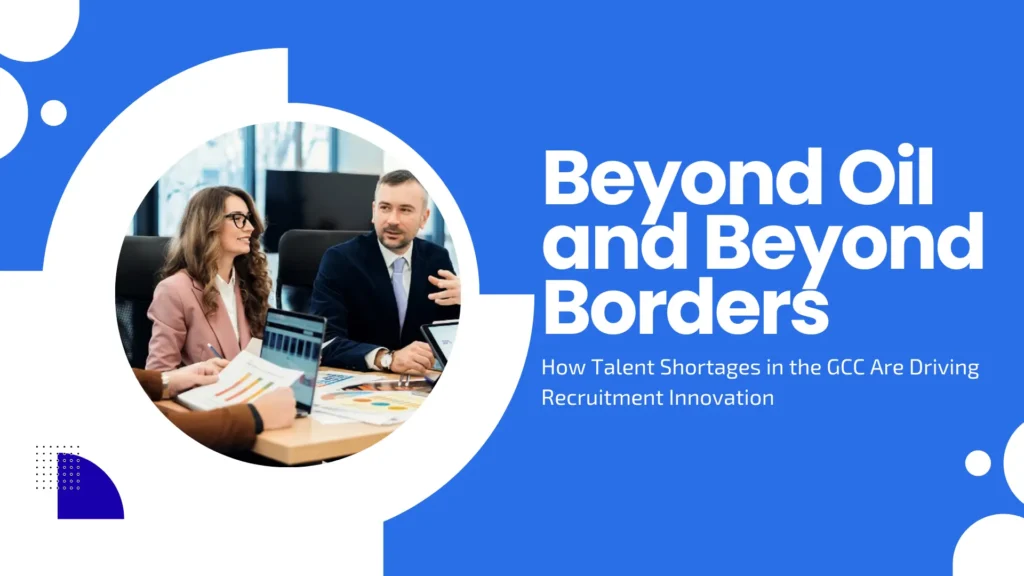
If you have been keeping an eye on the job market or thinking about where to expand your business next, you have probably noticed the buzz around the Gulf Cooperation Council (GCC) states. We are talking about Saudi Arabia, the UAE, and Qatar—a region that seems to be building the future at warp speed.
But here is the reality check that keeps HR leaders up at night: there simply aren’t enough skilled people to fill all the roles being created.
This isn’t just a temporary hiccup. It is a structural shift. With massive projects like NEOM project jobs opening up and entire economic cities rising from the desert, the demand for talent has outpaced the local supply. The result? A fascinating wave of innovation in how companies recruit, retain, and treat their people.
Whether you are an Arab American professional eyeing a move “back home” to the region, a US employer looking at business expansion in GCC markets, or a local company trying to build a world-class team, the rules of the game have changed. Let’s break down what is really happening on the ground in 2026.
The Great GCC Talent Squeeze
Let’s get the stats out of the way early because they are staggering. According to recent industry data, a whopping 90% of organisations in the region are reporting skills gaps . Think about that. Nine out of ten companies can’t find the people they need.
This scarcity is driving a massive cultural shift. For decades, the GCC hiring model was largely employer-driven. You posted a job, you got hundreds of CVs, and you picked the candidate with the right degree. Today, the power dynamic has flipped. 72% of professionals in the GCC are open to changing roles . They know they are in demand, and they are acting like it.
This isn’t just about salary anymore—although that helps. It is about creating an environment where people want to stay. As one industry event put it recently, leaders need to ask themselves: “If employees can leave, why would they choose to stay?” . That question is at the heart of every recruitment innovation we are seeing today.
Innovation #1: Rethinking the Expat Package (It’s Not Just About the Housing Allowance)
For years, the expat value proposition was simple: tax-free salary, a villa, and a driver. But if you look at the Dubai expat salary guide versus the cost of living Dubai vs USA, you will see that the pure financial arbitrage isn’t what it used to be.
The innovators in recruitment are now selling a lifestyle and a career trajectory, not just a paycheck.
We are seeing a huge shift towards expat retention Dubai strategies that focus on holistic support. It is no longer enough to fly someone in and drop them in a hotel. Companies are investing heavily in relocation support Middle East programs that go beyond the logistics. They are helping spouses find work (where visas allow), connecting children to the right schools, and facilitating integration into the American community in UAE or other expat bubbles to ease the transition.
Why? Because loneliness is still the number one reason expats pack up and leave before their contract is up. Savvy employers are now offering family support UAE programs and cross-cultural training not just for the employee, but for their whole family.
Innovation #2: Hyper-Localization and National Vision Alignment
If you are considering setting up a team in Saudi Arabia, you need to understand Saudi Vision 2030—not as a government slogan, but as a business reality.
Nationalization policies (like Saudization and Emiratisation) are maturing. In Saudi Arabia, 93% of employers already employ Saudi nationals, and 75% plan to increase that number . The innovation here is that companies are moving from “checking a box” to genuinely developing local talent.
For the foreign job seeker, this means the competition is changing. The old model of importing an entire middle management layer is fading. Instead, we are seeing a hybrid model where senior experts are brought in to mentor and upskill local talent. This creates a huge demand for leaders who are not just technically proficient, but who are also great coaches and culturally sensitive.
For US employers, this means that when you staff your new office in Riyadh, you need a blend of global expertise and local knowledge. You need leaders who understand the GCC business climate but can also navigate the nuances of hiring in Riyadh.
Innovation #3: The Rise of the “Boomerang” Hire (Arab Professionals Returning Home)
This is where it gets really interesting for the Arab American community. We are seeing a massive wave of reverse migration.
For decades, the promise of the American Dream drew top talent from the Middle East to the US. But now, the opportunities in the Gulf are too big to ignore. From fintech careers Dubai to renewable energy jobs Saudi Arabia, the GCC is actively courting its diaspora.
This isn’t just about filling jobs; it is about bringing home skills. An engineer who worked on US infrastructure projects brings a different mindset to a NEOM careers 2024 role. A doctor who trained in Chicago understands a different standard of patient care.
For Arab tech professionals USA jobs, the draw is particularly strong. The GCC is building smart cities from scratch. The chance to work on a “greenfield” project—building a tech ecosystem with no legacy code or old infrastructure—is a career-defining opportunity that is hard to find in the saturated US market.
Innovation #4: Streamlining the Visa Maze
Let’s talk about the boring stuff that actually matters: visas. Nothing kills a recruitment drive faster than a complicated relocation.
The good news is that GCC countries have realized this and are racing to make themselves more accessible. The introduction of the Golden Visa and freelance permits in the UAE has made it easier for top talent to put down roots.
For those looking at the Saudi Arabia work visa process, things are also getting smoother, though it remains bureaucratic. The key innovation here is in how companies manage this. Instead of leaving the employee to figure it out, top employers are building concierge-level mobility teams.
On the flip side, for Arab professionals looking to move to the US, the pathway remains the H1B visa for software engineers or academic routes. It is a lottery system, which is frustratingly unpredictable. However, we are seeing more US companies open remote roles specifically targeting talent in the region, delaying the need for immediate relocation. If you are seeking US healthcare jobs for Arab medical professionals, the process is rigorous—requiring USMLE for Arab doctors or a specific nursing license USA—but the demand for bilingual staff in US hospitals is growing steadily.
Innovation #5: The “Project” Mindset vs. The “Job” Mindset
If you look at the landscape of megaprojects jobs, you will notice something interesting: the rise of the contractor.
As companies face economic uncertainty—and let’s be real, global geopolitics always adds a layer of complexity to the region —they are getting flexible. Instead of committing to a massive permanent headcount, many firms are hiring for specific projects.
This is fantastic news for skilled professionals. It means you can go work on a massive tourism jobs Qatar project for 18 months, then pivot to a fintech careers Dubai role without being labeled a “job hopper.” It creates a dynamic, fluid labor market where skills are the only currency that matters.
Practical Advice for Employers: Setting Up for Success
If you are a US employer looking at business expansion in gcc market comparison to decide where to land, here is my practical advice:
- Saudi Arabia: Plan for a longer lead time. KSA recruitment requires patience. You need to show a commitment to the Vision. If you are hiring in Riyadh, budget for higher-end housing and schooling—the demand has driven prices up. Look into the various economic zones; depending on your industry, setting up in a specific zone can offer regulatory advantages.
- UAE: The Dubai free zone setup is still the gold standard for speed and ease. The UAE talent pool is the most diverse in the region, meaning you can find almost any skill set. However, that also means competition is fierce. Retention is your biggest challenge here, not attraction.
- Qatar: Post-World Cup, Qatar recruitment laws have stabilized, but the market is more focused on legacy projects now. There are still great opportunities in education and healthcare.
And no matter where you set up, do not skip the soft stuff. Cross-cultural training for your managers isn’t a nice-to-have; it is how you stop misunderstandings that lead to turnover. If you are managing remote teams in different time zones between the US and the Gulf, you need to establish protocols for “follow the sun” workflows.
Opportunities for Job Seekers: Where to Look in 2024/2025
What is hot right now?
- Tech & AI: The UAE is going all-in on AI. If you have experience in data science or machine learning, you are in the driver’s seat .
- Renewables: With Saudi Arabia’s commitment to the green transition, there is a surge in demand for engineers who understand solar and wind.
- Healthcare: The US market still has a massive shortage. For Arab medical professionals, the pathway is tough (the exams are brutal), but the payoff is a stable, high-income life in the US. For those wanting to work in the Gulf, hospitals are desperate for bilingual customer support center staff and specialized clinicians.
- Finance: With the UAE corporate tax rollout, there is a massive demand for finance professionals who understand compliance and reporting .
FAQ: Your Questions Answered
Q: How can a US business practically set up a team in Saudi Arabia or Dubai?
A: Start with a market entry consultant. Do not try to DIY the legal structure. In Dubai, you will likely choose a Dubai free zone setup for 100% ownership. In Saudi, you need to register with the Ministry of Investment (MISA). Once the entity is live, you need a local sponsor or partner in some cases, and then you can start the Saudi Arabia work visa process for your employees. It usually takes 3-6 months from decision to first hire on the ground.
Q: What are the requirements for Arab professionals to work in the US vs. the GCC?
A: For the US, it is usually employer-sponsored. You need a company to file an H1B or an L-1 (intra-company transfer) for you. It is a lottery, so there is luck involved. For healthcare, you must pass the US licensing exams (USMLE, NCLEX) before you can even apply for visa sponsorship for healthcare workers. For the GCC, the process is more straightforward. You need a job offer, a clean bill of health, and a police clearance. The employer typically handles the visa, and you enter on a work residency permit.
Q: How can expatriates integrate smoothly and stay long-term in the Middle East?
A: Fight the urge to stay in the bubble. Yes, the compounds are comfortable, but real integration happens when you engage with the culture. Learn a few phrases in Arabic, respect local customs during Ramadan, and build friendships with locals. Also, understand the financials. With rising costs, ensure your package is still competitive. Finally, look at the long-term visa options like the Golden Visa in the UAE, which gives you stability and reduces the “temporary” feeling.
Q: Which sectors offer the strongest opportunities right now?
A: Without a doubt, the megaprojects (NEOM, Red Sea Project, etc.) are driving demand for construction, engineering, and project management. In the cities, fintech and renewable energy are booming. For those looking at US healthcare jobs, geriatric care and nursing are desperate for qualified staff.
The Bottom Line
The talent shortage in the GCC is not a problem to be solved; it is a condition to be managed. It has forced the region to grow up fast, moving from a purely transactional labor market to a relationship-driven talent ecosystem.
For employers, this means you have to sell your vision and your culture as hard as you sell the salary.
For job seekers, it means your skills have never been more valuable.
Navigating this landscape—whether you are working in Dubai as an American or helping a US firm start a US Arab joint venture—requires a partner who understands both sides of the equation.
At Arab American Recruiters, we have spent years bridging this gap. We understand the nuances of placing Arab professionals in the US market and helping GCC businesses find the international talent they need to grow. From managing the logistics of onboarding expatriates in Middle East to finding the perfect cultural fit for a multilingual call center setup, we are here to make the connection.
Ready to build your bridge?
Contact Arab American Recruiters to start your talent search today.