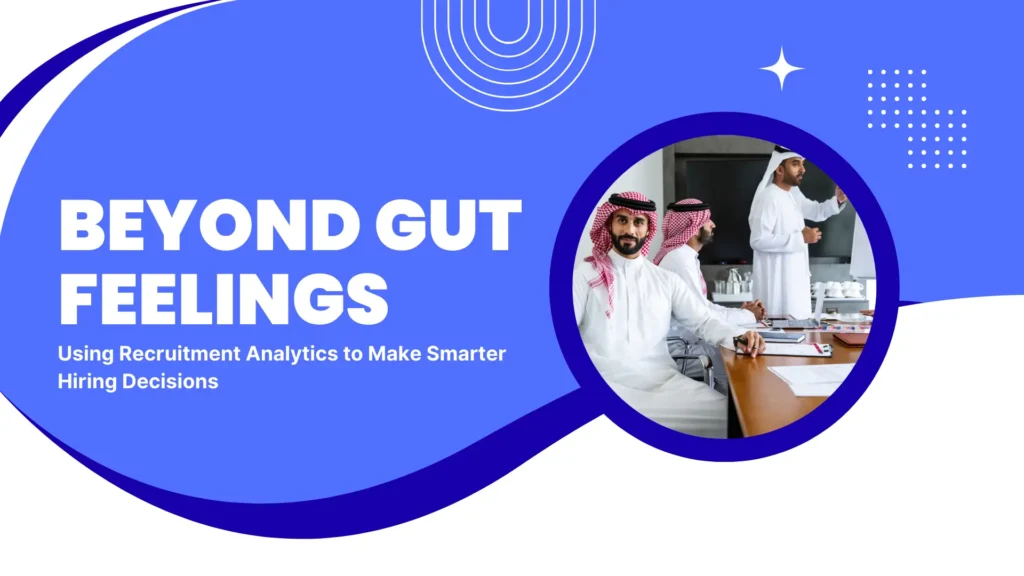
We have all been there. You interview a candidate who seems perfect on paper, says all the right things, and has a firm handshake. You hire them, and six months later, it is just not working out. The cultural fit is off, they are missing key skills, or they are already looking for their next move.
In the old days, we called that a “bad hire” and wrote it off as a gut feeling gone wrong. But in today’s worldwhether you are **hiring in Riyadh, building a team for a Dubai free zone setup, or recruiting Arab tech professionals in the USA you cannot afford to rely on intuition alone. The stakes are too high, and the competition for top talent is too fierce.
This is where recruitment analytics comes in. It is the practice of using data to improve how you hire. It sounds technical, but it is really just about replacing guesswork with insight. Let’s break down how you can use it to make smarter decisions, whether you are an employer expanding internationally or a professional navigating your next career move.
Why Analytics Matter in a Global Market
The world of work is changing fast. In the Gulf, **GCC economic diversification** and megaprojects are creating thousands of roles. In the US, companies are desperate for specialized talent in tech and healthcare.
When you are dealing with cross-border moveslike relocating a family to the UAE or navigating a Saudi Arabia work visa the cost of a bad hire multiplies. You are not just paying for a recruiter; you are paying for flights, visas, and relocation support in the Middle East.
Recruitment analytics helps you answer three critical questions:
1. Where are we finding our best people?
2. How do we know they will succeed once hired?
3. Why do they stay (or leave)?
Let’s look at how to apply this practically.
For Employers: Building Smarter Hiring Engines
If you are a US employer looking internationally or a GCC business scaling up, your hiring process needs an upgrade. Here is how to use analytics to protect your investment.
1. Stop Guessing, Start Tracking Quality of Hire
The biggest challenge companies face is collecting good data on what happens *after* someone is hired . It is easy to track how many people apply, but do you know how long it takes your new hires to become productive? Or how many stay past the first year?
If you are setting up a team in Saudi Arabia or hiring for a NEOM project job, you need to track these metrics. If your new project managers are burning out within six months, your sourcing data is telling you something. Maybe you are attracting the wrong profile, or perhaps you are not setting expectations correctly during the interview process.
2. Use Data to Navigate Localization (Saudization, Qatarization)
One of the trickiest parts of KSA recruitment or hiring in Qatar is compliance with local laws. As we see with Qatar recruitment laws and Saudization quotas, the rules are fluid .
Analytics can help you stay ahead. Instead of panicking when a new quota is announced, use workforce data to plan your pipeline. Which roles are hardest to fill with local talent? Where do you need to invest in training? By analyzing the UAE talent pool versus your needs, you can build a sustainable hiring plan that balances expat expertise with local national development. This is crucial for long-term business expansion in GCC market comparison strategies.
3. Predict Retention Before You Make the Offer
Hiring is expensive, but turnover is a killerespecially in the Gulf, where expat retention Dubai strategies are critical. Data shows that retention is often linked to factors beyond salary, like flexibility and career development .
When hiring for fintech careers Dubai or renewable energy jobs Saudi Arabia, look at your data. Do your best employees come from certain backgrounds? Do they value family support? If you notice that employees with strong family support networks stay longer, you might prioritize candidates whose families are eager to relocate. This is where analytics meets the human touch.
4. The Physical Presence Reality
If you are a US company looking at the Gulf, remember that data cannot magic away logistics. Unlike the remote-friendly US, countries like Saudi and the UAE often require a physical office to get visas . Your recruitment analytics should account for this. If you are planning a Dubai free zone setup, factor in the time it takes to lease that space and get your public relations officer (PRO) in place before you start hiring.
For Job Seekers: Using Data to Find Your Edge
If you are an Arab American professional looking to move to the Gulf, or a Westerner eyeing careers in the Middle East, you are also part of this data revolution. You can use market intelligence to your advantage.
1. Follow the Money (and the Megaprojects)
Do not just apply randomly. Look at the data. Where is the investment going? In Saudi Arabia, Saudi Vision 2030 jobs for foreigners are concentrated in specific areas. The NEOM careers 2024 listings show a massive demand for project management and engineering talent .
If you are in tech, look at the fintech careers Dubai boom. If you are in healthcare, the US market is desperate for bilingual staff, with roles specifically seeking Arabic speakers to serve local communities . Align your search with the sectors spending the most money.
2. Understand the Visa Landscape
Data helps you manage expectations. For the US, the H1B visa for software engineers is a lottery; it is a numbers game. For the Gulf, the process is employer-driven.
If you want a Saudi Arabia work visa, you need a sponsor. There is no getting around it. However, the data shows that processing times and requirements vary. Knowing that you need to register with the Ministry of Human Resources and Social Development (MHRSD) and have a labor contract before you arrive can save you months of headaches .
3. Leverage Your Unique Value Proposition
In a data-driven market, uniqueness is your currency. A bilingual customer support center (Arabic/English) is a massive asset for any multinational. Companies setting up 24/7 support team structures need people who can bridge the time zone and language gap.
Whether you are looking at US healthcare jobs for Arab medical professionals or tourism jobs Qatar, highlight your cross-cultural fluency. The data shows that companies struggle with retention when employees feel isolated. If you can demonstrate that you have the family support or the cultural resilience to adapt, you become a much safer bet.
Cross-Cultural Communication: The Analytics of Connection
This is one area where the data is soft, but the impact is hard. Cross-cultural communication in business is often the difference between a team that thrives and one that fractures.
When managing remote teams across different time zones, analytics can help you schedule meetings when people are actually awake and productive. But more importantly, it can help you understand how your team communicates.
For example, if you are running a US-Arab joint venture project management team, you might notice that your US team prefers direct, critical feedback, while your Gulf-based team values relationship-building before business talk. Data on engagement and turnover will quickly tell you if your management style is working. If your turnover in Riyadh is high, the problem might not be the salary; it might be a lack of cross-cultural training for the managers.
Making It Work: Practical Tips for 2024
So, how do we actually do this without becoming data scientists?
For Employers:
Audit Your Sources: Where are your best NEOM project jobs candidates coming from? LinkedIn? A niche recruiter? Spend more money there.
Ask Better Questions: Instead of Where do you see yourself in 5 years?, ask behavioral questions that predict performance. Data shows that past behavior is the best indicator of future success .
Invest in Onboarding: Your data is useless if people quit in the first 90 days. Solid onboarding expatriates in Middle East programsincluding help with housing, schooling, and bankingpay for themselves in retention.
For Job Seekers:
Track Market Salaries: Do not rely on outdated forums. Look for a recent **Dubai expat salary guide or cost of living Dubai vs USA comparison. Know your worth.
Network with Purpose: Use platforms to find networking for Arab professionals in USA or specific groups for expats in Qatar. The data shows that referred candidates often have higher retention rates.
Get Licensed: If you are a doctor, understand the USMLE for Arab doctors requirements. If you are a nurse, know the nursing license USA process before you apply.
Industry Q&A
Q: How can businesses set up a team in Saudi Arabia or Dubai efficiently?
A: Start with the legal structure. In Dubai, a free zone setup (like Dubai Knowledge Park for HR firms) offers 100% ownership and easy visa processing . In Saudi, you need a physical license and a local PRO to handle government paperwork . Work with a consultant who knows the market. We often help clients map out the headcount and visa timelines before they sign a lease, ensuring the recruitment pipeline matches the legal setup.
Q: What are the requirements for Arab professionals to work in the US or GCC?
A: For the GCC, you need a job offer and employer sponsorship. The company handles the work visa (like the Saudi Arabia work visa or UAE labor card). For the US, it is tougher. Most Arab professionals use the H1B visa (lottery system) or come on an internal company transfer (L1 visa). In healthcare, passing the USMLE or state nursing boards is non-negotiable.
Q: How can expatriates integrate smoothly and stay long term in the Middle East?
A: Integration is about community. Companies that provide family support in UAEhelp with schools, finding housing in compounds, and spouse networking groupshave much higher retention . As an individual, say yes to every invitation for the first six months. Build your tribe. The expat community is welcoming, but you have to step into it.
Q: Which sectors offer the strongest opportunities in 2024?
A: The megaprojects. In Saudi, it is construction, engineering, and project management for NEOM and the Red Sea projects . In the UAE, fintech careers Dubai and renewable energy are exploding. In the US, healthcare and tech remain strong, especially for bilingual roles. The future skills in the Arabian Gulf are digitalAI, data science, and cybersecurityas the region diversifies away from oil.
The Bottom Line
Recruitment analytics is not about replacing the human element of hiring. It is about protecting it. By understanding the data behind who stays, who succeeds, and why, we can make better matches. And in a world of remote work, international moves, and massive projects, a good match is worth its weight in gold.
Whether you are a business looking to expand or a professional seeking your next adventure, let the data guide youbut let your instincts make the final call.
Navigating international hiring can be complex, but you do not have to do it alone. At Arab American Recruiters, we specialize in connecting top talent with opportunities across the US and GCC. From navigating expatriate onboarding to sourcing for megaprojects jobs, we are here to help you make data-backed decisions that work. Visit us at to learn more about how we can support your international hiring goals. ARAB AMERICAN