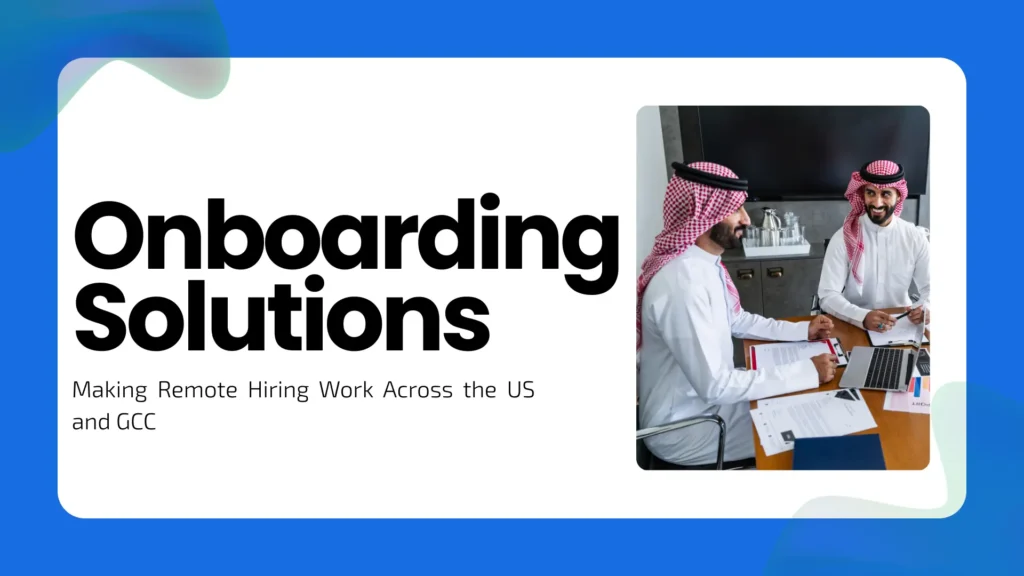
Remote hiring used to be a backup plan. Now it is a growth strategy.
Whether you are hiring in Riyadh, building a distributed tech team between Dubai and Texas, or helping Arab professionals transition into the US market, onboarding is the moment where success either accelerates or quietly falls apart.
I have seen brilliant hires fail because onboarding was rushed. I have also seen average candidates turn into star performers because they were supported properly from day one.
If you are serious about workforce mobility, international recruitment, and long term retention, you cannot treat onboarding as paperwork. It is strategy.
Let us break down what that means in practical terms for employers and professionals navigating the GCC and US markets.
Why Onboarding Is the Real Test of Remote Hiring
When you are:
- Setting up a team in Saudi Arabia
- Expanding through a Dubai free zone setup
- Navigating Qatar recruitment laws
- Sponsoring an H1B visa for software engineers
The contract is just the beginning.
Remote and cross border hiring adds layers:
- Immigration compliance
- Cultural expectations
- Time zone differences
- Family relocation considerations
- Communication styles
Without structure, small misunderstandings turn into performance issues.
With the right onboarding solutions, you create clarity, belonging, and momentum.
Saudi Arabia: Building Teams with Vision and Structure
Saudi Arabia is transforming rapidly under Vision 2030. That transformation is driving demand in technology, renewable energy, tourism, infrastructure, and large scale megaprojects.
Companies setting up a team in Saudi Arabia often focus on recruitment first and integration later. That is risky.
Practical Steps for Employers Hiring in Riyadh
If you are hiring in Riyadh or supporting roles linked to major development projects, here is what works:
- Clarify the Saudi Arabia work visa process early
Visa timelines and sponsorship structures should be explained to candidates upfront. If you are unsure about recent updates, I could not confirm this information; here is how you can verify it. Check directly with official Saudi government portals or licensed immigration advisors. - Align job expectations with local business culture
Decision making structures in KSA can be more hierarchical than in US firms. Make reporting lines explicit. - Provide relocation support Middle East style
Housing guidance, schooling information, and family transition planning matter more than many companies expect. - Offer cross cultural training
Especially when Western managers are leading Saudi teams or when Saudi professionals are working with US stakeholders.
Saudi Vision 2030 jobs for foreigners are increasing in sectors like renewable energy jobs Saudi Arabia and smart city development. But onboarding expatriates in Middle East contexts requires sensitivity to both local norms and global standards.
UAE: Fast Moving Market, High Expectations
The UAE remains one of the most attractive destinations for international talent. The UAE talent pool is diverse, competitive, and highly mobile.
Dubai in particular attracts professionals from across the Middle East, Europe, Asia, and North America.
What Employers Should Know About Dubai Expansion
If you are planning a Dubai free zone setup as part of a broader GCC expansion, onboarding must account for:
- Employment contracts structured under UAE law
- Visa sponsorship and medical requirements
- Housing allowances and cost of living differences
- Cultural diversity within teams
Many employers underestimate how important expat retention Dubai strategies are. Talent moves quickly in this market. If onboarding feels transactional, employees will explore other options within months.
For Americans considering working in Dubai as an American, onboarding clarity is equally important. Expectations around compensation, benefits, and lifestyle should be discussed honestly, especially when comparing cost of living Dubai vs USA.
Retention in the UAE Is About More Than Salary
Strong onboarding programs in the UAE typically include:
- Clear 90 day performance plans
- Mentorship inside the organization
- Cultural orientation
- Family support UAE services
The American community in UAE and broader expatriate networks can also help professionals integrate socially. Employers who actively encourage community engagement see stronger retention.
Qatar: Compliance First, Then Culture
Qatar recruitment laws have evolved in recent years, especially regarding mobility and employment protections. Employers must stay updated.
If you are expanding in Qatar, onboarding should focus on:
- Transparent employment terms
- Compliance with local labor regulations
- Clear communication of sponsorship responsibilities
Sectors such as tourism jobs Qatar and infrastructure development continue to create demand for skilled professionals. However, integration support is essential. Smaller markets amplify missteps.
Hiring Arab Professionals in the United States
Workforce mobility is not one directional. Many Arab professionals are pursuing careers in the United States.
From Arab tech professionals USA jobs to US healthcare jobs for Arab medical professionals, the pathway can be rewarding but complex.
Visa and Licensing Pathways
For tech professionals, the H1B visa for software engineers remains a key route. However, it is competitive and quota based.
For doctors and nurses:
- USMLE for Arab doctors is mandatory for medical practice
- Nursing license USA requirements vary by state
- Visa sponsorship for healthcare workers depends on employer and specialty
Employers hiring internationally into the US must:
- Start immigration processes early
- Provide realistic timelines
- Offer onboarding support that explains US workplace expectations
Without structured onboarding, international hires struggle not because of skill gaps, but because of system unfamiliarity.
Cross Cultural Communication Is Not Optional
When managing remote teams in different time zones, small communication gaps become expensive mistakes.
I often see three recurring issues:
- Assumptions about responsiveness
- Different interpretations of deadlines
- Indirect versus direct feedback styles
Cross cultural communication in business should be addressed proactively.
Practical Framework for Distributed Teams
- Define core overlap hours for collaboration
- Document decisions in writing
- Clarify escalation channels
- Train managers on cultural awareness
If you are running a 24 7 support team structure across the US and GCC, clarity in shift handovers and performance metrics is essential.
For bilingual customer support center Arabic English operations or talent for Arabic customer service in US markets, onboarding must also cover tone expectations and customer service norms across regions.
Expatriate Onboarding: Beyond the Job Description
Onboarding expatriates in Middle East environments requires attention to the whole person.
This includes:
- Immigration documentation
- Housing logistics
- Healthcare access
- Schooling for children
- Banking and local registration processes
Relocation support Middle East strategies that ignore family integration tend to fail.
I have seen highly skilled professionals leave within a year because their spouse struggled to adapt. Employers that provide family support UAE programs or equivalent guidance in Saudi Arabia and Qatar reduce early turnover significantly.
Sectors Driving Opportunity in 2024
Across the GCC and US, several sectors stand out.
In Saudi Arabia
- Renewable energy jobs Saudi Arabia
- Large scale megaprojects jobs linked to urban development
- Technology roles tied to digital transformation
In the UAE
- Fintech careers Dubai
- Multilingual call center setup for regional operations
- Advanced logistics and trade services
In Qatar
- Tourism jobs Qatar
- Infrastructure and event related services
In the United States
- Technology and software engineering
- Healthcare including doctors and nurses
- US Arab joint venture project management roles
The GCC business climate continues to evolve as part of broader GCC economic diversification. Employers who understand the regional context onboard faster and retain better.
A Note on Specialized Recruitment Support
Firms such as Arab American Recruiters have built experience placing Arab professionals in both US and GCC markets. Their work often involves complex international hiring projects and expatriate onboarding support.
The value in specialized recruitment partners is not just sourcing candidates. It is navigating compliance, cultural alignment, and long term integration.
That said, whether you work with a recruitment partner or build internal capability, onboarding remains your responsibility as an employer.
Industry FAQ
How can businesses set up a team in Saudi Arabia or Dubai?
Start by choosing the right legal structure. In Saudi Arabia, understand local entity requirements and sponsorship rules linked to the Saudi Arabia work visa process. In the UAE, consider whether a mainland license or Dubai free zone setup fits your business model.
Then:
- Partner with local legal advisors
- Clarify visa and labor compliance
- Build a structured onboarding plan before your first hire
Recruitment is step one. Integration is step two.
What are the requirements for Arab professionals to work in the US or GCC?
In the US, requirements depend on profession. Tech roles often require H1B sponsorship. Medical professionals must complete licensing steps such as USMLE for Arab doctors or state based nursing license USA processes.
In the GCC, professionals need employer sponsored work visas, verified qualifications, and in some cases credential authentication.
Because regulations change, always verify through official government channels or licensed advisors.
How can expatriates integrate smoothly and stay long term in the Middle East?
Successful expatriates:
- Learn basic cultural norms
- Build local networks
- Involve their families in the transition
- Communicate openly with managers
Employers should provide relocation support Middle East services, mentorship, and clear career progression pathways. Expat retention Dubai and similar markets improves dramatically when employees feel both professionally and socially anchored.
Which sectors offer the strongest opportunities in 2024?
Technology, renewable energy, healthcare, tourism, fintech, and large infrastructure projects are leading across Saudi Arabia, UAE, Qatar, and the United States.
Professionals with bilingual skills, digital expertise, and cross border experience are especially competitive.
Final Thoughts: Onboarding Is Your Competitive Advantage
Remote hiring across the US and GCC is no longer experimental. It is strategic.
But here is the reality. The companies that win are not the ones that hire the fastest. They are the ones that integrate the smartest.
If you are expanding in Saudi Arabia, building teams in Dubai, navigating Qatar recruitment laws, or sponsoring Arab professionals into US roles, your onboarding system determines your retention rate, productivity curve, and employer reputation.
Treat onboarding as infrastructure. Not paperwork.
If you need guidance on international hiring, expatriate onboarding, or placing Arab professionals in the US and GCC markets, you can explore the expertise of Arab American Recruiters to understand how cross border recruitment projects are structured in practice.
Build the team. Support the transition. Manage the culture. That is how remote hiring truly works.