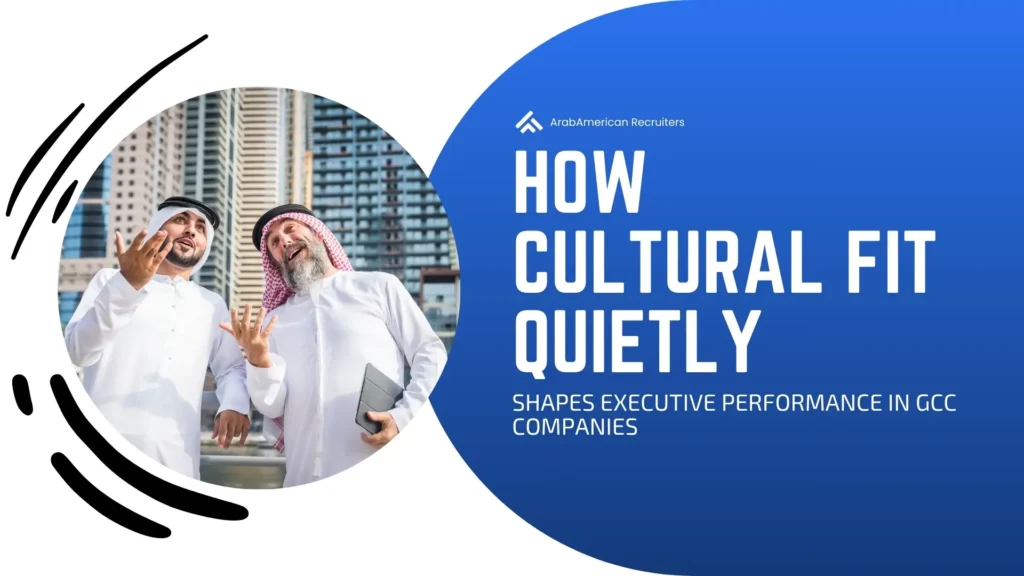
When companies expand into the Gulf, most leadership conversations focus on strategy, compensation, and market entry. Those things matter. But after years of watching executives succeed or struggle in Saudi Arabia, the UAE, and Qatar, one factor keeps showing up as the difference maker. Cultural fit.
In GCC companies, cultural fit is not about liking the food or knowing a few Arabic phrases. It is about how leaders make decisions, build trust, communicate authority, and navigate relationships in environments that value history, hierarchy, and long term vision.
For Arab American professionals, US employers hiring internationally, and GCC businesses building global teams, understanding this reality is no longer optional. It directly impacts executive performance, retention, and the overall health of the organization.
Let us break this down in a practical, real world way.
Why cultural fit matters more at the executive level
At junior and mid level roles, skills can sometimes outweigh cultural misalignment. At the executive level, that margin disappears.
Senior leaders in the GCC are expected to do more than deliver results. They represent the organization internally and externally. They interact with regulators, family owned partners, government stakeholders, and diverse multinational teams. A leader who does not understand how business relationships work in the GCC can unintentionally damage trust even while hitting their KPIs.
This is especially visible during business expansion in GCC market comparison discussions. Two executives with similar resumes can perform very differently depending on how well they adapt to local expectations.
Cultural fit affects how executives handle:
• Decision making speed and consultation
• Authority and respect in hierarchical settings
• Conflict resolution without public confrontation
• Relationship building beyond transactional meetings
When these elements are ignored, even technically strong leaders struggle.
Saudi Arabia and the leadership shift under Vision 2030
Saudi Arabia is changing fast, but cultural expectations remain deeply rooted. Executives working on setting up a team in Saudi Arabia or hiring in Riyadh often underestimate this balance between transformation and tradition.
Vision 2030 has opened doors across technology, renewable energy, tourism, and megaprojects jobs. Initiatives connected to NEOM project jobs and Saudi Vision 2030 jobs for foreigners attract global executives who bring fresh ideas. The ones who succeed understand when to push change and when to listen first.
In Saudi workplaces, respect, patience, and relationship building still carry enormous weight. Decisions may involve more stakeholders than US executives are used to. Meetings may focus on alignment before action. Leaders who interpret this as inefficiency usually fail. Leaders who see it as consensus building thrive.
From a compliance perspective, understanding the Saudi Arabia work visa process and working with experienced KSA recruitment partners also reduces friction. But paperwork alone does not solve cultural missteps.
UAE leadership culture and the expat reality
The UAE feels familiar to many Western executives at first glance. English is widely used, offices are international, and Dubai free zone setup options make entry easier for foreign companies. This familiarity can be misleading.
The UAE talent pool is diverse, but leadership norms are still shaped by regional values. Executives must manage teams made up of dozens of nationalities while respecting local business etiquette.
Cultural fit in the UAE often shows up in subtle ways:
• How feedback is delivered without causing loss of face
• How authority is exercised without appearing dismissive
• How long term loyalty is built in a fast moving market
Expat retention Dubai remains a challenge for many companies because executives underestimate the importance of onboarding expatriates in Middle East environments. Leaders who actively support relocation support Middle East initiatives and family support UAE policies tend to retain stronger teams.
This is especially true for Americans exploring working in Dubai as an American. Compensation matters, but leadership stability and cultural awareness matter more over time.
Qatar and the importance of institutional respect
Qatar offers strong opportunities in energy, infrastructure, and tourism jobs Qatar continues to develop. However, Qatar recruitment laws and workplace norms are more formal than many expect.
Executives who perform well in Qatar usually demonstrate:
• High respect for institutional processes
• Clear boundaries between authority and collaboration
• Cultural sensitivity in mixed national teams
Here again, cultural fit affects executive credibility. Leaders who rush decisions or bypass established protocols often lose trust, even if their intentions are positive.
Cultural fit and cross border leadership for Arab American professionals
Arab American professionals often sit at a unique advantage. Many understand both Western corporate expectations and Middle Eastern cultural norms. This makes them particularly effective in senior roles across GCC companies and US based organizations with regional operations.
For Arab tech professionals USA jobs remain attractive, especially when paired with USA tech relocation support. Others pursue leadership roles in the Gulf where their bicultural perspective helps bridge gaps between global strategy and local execution.
Executives who have lived and worked in both regions tend to excel at managing remote teams in different time zones. They understand communication gaps before they become conflicts.
Organizations like Arab American Recruiters have built experience placing Arab professionals in both the US and GCC, often focusing on roles where cultural fluency is as important as technical expertise.
What US employers often miss when hiring for the GCC
US employers expanding internationally often approach leadership hiring as a skills matching exercise. They focus on industry background, revenue targets, and operational experience. Cultural fit gets mentioned but not deeply assessed.
This leads to avoidable failures.
When US companies hire executives for GCC roles without cultural preparation, they often see:
• Early burnout due to social and family adjustment issues
• Misalignment with local partners
• High turnover despite competitive compensation
Investing in cross cultural training before relocation is not a luxury. It is risk management. Even basic preparation around communication styles, decision making norms, and relationship building can significantly improve executive performance.
Retaining executives in the Gulf requires more than salary
Retention is where cultural fit proves its value long term. Executives who feel socially isolated or misunderstood rarely stay, no matter how attractive the package.
Strong expat retention Dubai and Saudi markets share similar drivers:
• Support for spouses and children
• Clear career progression beyond the first contract
• Respect for cultural identity and work life balance
Companies that actively plan for these factors during onboarding expatriates in Middle East operations see stronger loyalty and performance.
Practical guidance for employers
If you are building leadership teams in the GCC, here are practical steps that actually work.
First, assess cultural adaptability during interviews. Ask candidates how they handled ambiguity, hierarchy, and cross cultural conflict in past roles.
Second, partner with recruiters who understand both markets. KSA recruitment and UAE hiring are not identical. Local insight matters.
Third, provide structured onboarding that covers business culture, not just HR policies.
Fourth, support executives beyond the office. Relocation support Middle East programs and family support UAE policies reduce early exits.
Finally, align expectations early. Be honest about decision making timelines, stakeholder involvement, and success metrics.
Practical guidance for executives and job seekers
For professionals considering careers in the Gulf or the US, cultural fit is a career asset.
If you are exploring careers in Middle East for westerners or Arab professionals moving between regions, focus on roles where your cultural awareness is valued.
High demand sectors include:
• Renewable energy jobs Saudi Arabia
• Fintech careers Dubai
• Tourism and infrastructure roles in Qatar
• Technology leadership tied to GCC economic diversification
Understanding visa pathways matters too. Whether it is a Saudi Arabia work visa or planning for H1B visa for software engineers in the US, compliance planning should start early.
Networking for Arab professionals in USA also plays a major role in long term career mobility.
Industry questions people keep asking
How can businesses set up a team in Saudi Arabia or Dubai
Start with legal structure and compliance, then focus on leadership hiring. Dubai free zone setup can simplify entry, while Saudi operations often require deeper local engagement. Cultural preparation should happen alongside legal planning.
What are the requirements for Arab professionals to work in the US or GCC
Requirements vary by role and country. In the GCC, work visas are employer sponsored. In the US, pathways like H1B for tech roles are common. I could not confirm specific timelines since they change frequently. You can verify through official immigration authorities or licensed advisors.
How can expatriates integrate smoothly and stay long term in the Middle East
Success comes from patience, curiosity, and community. Learn how decisions are made, build relationships outside the office, and choose employers that invest in onboarding and family support.
Which sectors offer the strongest opportunities in 2024
Technology, renewable energy, fintech, healthcare, and large scale megaprojects jobs continue to grow. Leadership roles tied to future skills in Arabian Gulf markets are especially strong.
A final thought for leaders and companies
Cultural fit is not about changing who you are. It is about understanding where you are. Executives who respect local norms while bringing global perspective consistently outperform those who rely on authority alone.
If you are hiring, relocating, or planning your next leadership move between the US and the GCC, treat cultural fit as a core business strategy. It pays dividends long after the contract is signed.
Ready to explore international hiring or career moves
If you want guidance from professionals experienced in placing Arab professionals across the US and GCC, including executive roles and expatriate onboarding, you can explore insights and resources from Arab American Recruiters.