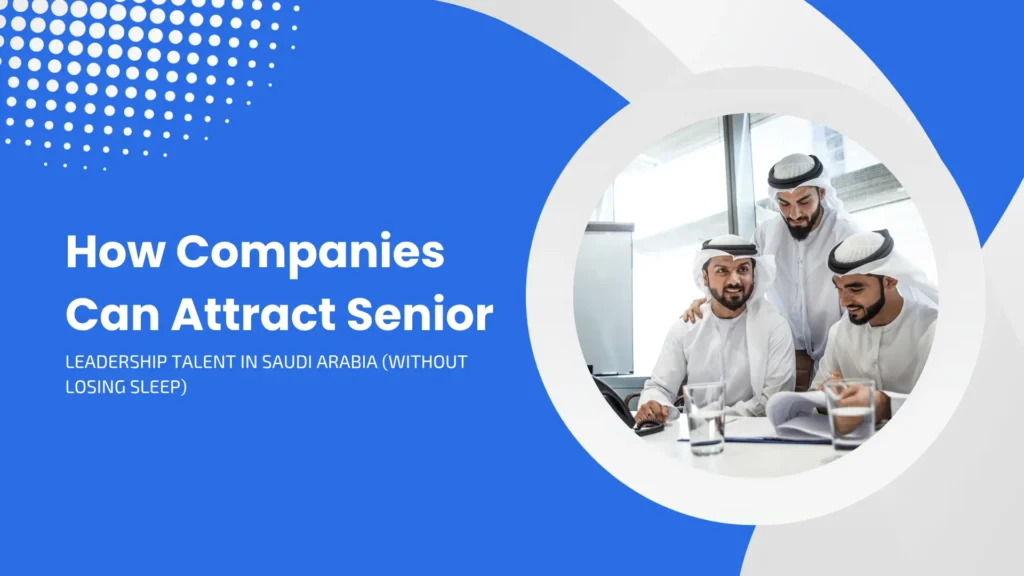
Let’s be honest for a second. If you are a US employer or a GCC-based business trying to expand right now, you have probably stared at a spreadsheet titled “Saudi Expansion” and felt your eye twitch.
You know the potential is massive. Between Saudi Vision 2030 jobs for foreigners and the sheer pace of NEOM project jobs, the Kingdom is the hottest ticket in the global economy. But here is the rub: Finding a CFO in Jeddah or a Head of Operations in Riyadh is hard. Attracting them? That is a whole different ball game.
I have spent years watching US companies trip over their own shoelaces trying to recruit senior Arab talent, only to lose the candidate to a local firm down the street. Why? Because leaders aren’t looking for just a paycheck. They are looking for a mission, stability, and a soft place to land.
Whether you are an Arab American professional eyeing a move back to the region, or a US hiring manager dipping your toes into ksa recruitment, here is the real talk on how to woo the C-suite in the new Saudi Arabia.
Stop Recruiting. Start Storytelling.
Senior leaders already have jobs. They probably have good ones. You are not selling a role; you are selling a chapter in their life.
The biggest shift I have seen in the gcc business climate is the move from generic job descriptions to “Vision 2030” narratives. If you are hiring in Riyadh, you are not just looking for a Head of Finance. You are looking for someone to build the financial skeleton of a multi-billion dollar megaprojects job. That feels different.
When you write that job ad, ditch the corporate vomit of “synergies” and “leveraging assets.” Talk about impact. Say things like: “You will be responsible for the financial structuring of a new renewable energy zone that will power 200,000 homes.”
For Arab American professionals reading this: You have a secret weapon. You understand the US work ethic (efficiency, directness, speed) and the GCC business culture (relationship-first, hierarchical, long-term). That hybrid view is worth gold right now. But you need to see if the employer actually understands what they are asking for.
The Visa & Compliance Landmine (Don’t Wing This)
Nothing kills the vibe of a great hire like a saudi arabia work visa process that takes six months.
Senior leaders will jump ship if your onboarding is a mess. I have seen deals fall apart because the HR person sent the wrong link for the medical exam. You have to be surgical.
- For US employers: You cannot just fly someone in on a business visa and have them start working. That gets you banned. You need a legal entity or a Professional Employment Organization (PEO) to sponsor the saudi arabia work visa.
- For GCC businesses: If you are expanding from Dubai, do not assume the rules are the same. Qatar recruitment laws differ from Saudi labor law. In Saudi, the Qiwa platform and Muqeem are your bibles. Ignore them at your peril.
The companies that win are the ones that have a dedicated mobility person (or hire experts like Arab American Recruiters) to hold the candidate’s hand through the degree attestation, the medicals, and the biometrics. If you leave a senior VP waiting in an airport lounge for four hours because the visa wasn’t ready, you have lost them forever.
The “Family Factor” Is Non-Negotiable
Here is a truth that many Western companies ignore: For senior talent moving to the Middle East, the spouse and kids make the final decision.
You can offer a huge salary, but if the spouse is bored or the kids can’t get into a good school, the answer is no.
When you are onboarding expatriates in Middle East, you must wrap your arms around relocation support middle east that goes beyond shipping boxes. We are talking about:
- School search consultations.
- Family support uae (or KSA) – helping the spouse find a community, a gym, or even a volunteer role.
- Housing allowances that actually cover the new reality of rents in Riyadh (they have gone up, folks).
For the job seeker (especially if you are an American looking at working in dubai as an american vs. Saudi): Do the math. A dubai expat salary guide looks shiny, but cost of living dubai vs usa is narrowing. In Saudi, the savings potential is often higher because of no income tax and lower housing costs outside of the diplomatic quarter. But the lifestyle is different. Be honest about what you want for your weekends.
Cross-Cultural Training Isn’t Soft Skills; It’s Survival
I am going to get on my soapbox for a second.
I cannot count how many US tech companies have blown up a good Saudi hire because they ran a “scrum meeting” at 4:00 PM on a Thursday.
If you are managing a us arab joint venture project management team, you need cross-cultural training yesterday.
- The US style: Time is money. Let’s cut to the chase, solve the problem, and hang up.
- The GCC style: Time is relationship. Let’s have tea. Let’s ask about the kids. The business part comes after we trust each other.
If you are an Arab American leader working for a US parent company, you will likely become the bridge. You will spend your days managing remote teams in different time zones (New York to Riyadh is 7 hoursgood luck with that morning standup). You need to teach your US colleagues that “Inshallah” doesn’t always mean “maybe”; sometimes it means “I hear you, but let’s see.”
Businesses that succeed here are the ones that budget for a cross-cultural training module before the hire starts. It saves millions in misunderstandings.
Don’t Sleep on the UAE vs. Saudi Comparison
While Saudi is the hot market, the UAE is the established hub. Many senior leaders will take a job setting up a team in saudi arabia but keep their family in Dubai. That is expensive, but it happens.
When doing a business expansion in gcc market comparison, know that dubai free zone setup is easier for 100% foreign ownership and repatriation of cash. Saudi is catching up (with the RSP and special zones), but the paperwork is heavier.
If you need talent fast, look at the uae talent pool. There are thousands of experienced expats in Dubai right now who are bored. They have done the mall, they have done the brunch. They are hungry for the challenge of neom careers 2024 or the renewable energy jobs saudi arabia offers. They just need a plane ticket and a good housing package.
The High-Demand Sectors (Where the Leaders Are)
As of 2024, if you are looking for leadership or you are a candidate looking to move, focus on these verticals:
- Tech: fintech careers dubai and Saudi are exploding. The need for CTOs who understand open banking and Shariah-compliant fintech is huge.
- Healthcare: With the expansion of medical cities, us healthcare jobs for arab medical professionals are plentiful. If you are a doctor, look into the usmle for arab doctors pathways; but also, the nursing license usa has reciprocity options that can lead to CNO roles in Riyadh.
- Renewables: It is all about renewable energy jobs saudi arabia (think ACWA Power and the Green Initiative).
- Tourism: tourism jobs qatar and Saudi (Red Sea Project) need hospitality GMs who can handle luxury scale.
- Call Centers (Bilingual): bilingual customer support center arabic english management is a niche skill. If you have run a multilingual call center setup before, you are a unicorn. The demand for talent for arabic customer service is insane, especially for 24/7 support team structure roles.
FAQ: Your Burning Questions Answered
Q: How can a US business actually set up a team in Saudi Arabia or Dubai without losing their shirt?
A: For Dubai, look at a dubai free zone setup (like DIFC for finance or DMCC for trading). It’s fast. For Saudi, you need a license from MISA (Ministry of Investment). Most smart US companies start with an “Employer of Record” (EOR) to handle payroll and saudi arabia work visa compliance for the first 6 months while they get their legal entity sorted. Do not try to DIY the labor law; you will get fined.
Q: What are the real requirements for Arab professionals to work in the US vs. the GCC?
A: For the US, it is a lottery or sponsorship. If you are a software engineer, the h1b visa for software engineers is the golden ticket, but it’s a gamble. Usa tech relocation is easier if you work for a multinational that transfers you internally (L-1 visa). For the GCC, it is easier on the visa front (employer sponsors you), but harder on the culture front. You need a local sponsor. For Arab Americans, networking for arab professionals in usa often happens via associations like ACCESS, while in the GCC, it is all about Wasta (connections)who you know.
Q: How can expatriates integrate and stay long-term in the Middle East?
A: Rent, don’t buy, for the first year. Get a local SIM card immediately. Learn 10 phrases of Arabic (not for work, for the supermarket). Join the american community in uae or the American Women’s Association in Riyadh. The people who last are the ones who stop comparing everything to “back home.” Also, use expat retention dubai strategiesbasically, keep giving them new projects. Leaders get bored fast. If you aren’t rotating their responsibilities every 18 months, they will leave.
Q: Which sectors offer the strongest opportunities for leadership in 2024?
A: Hands down, saudi vision 2030 jobs for foreigners in logistics, neom project jobs in construction management, and fintech careers dubai. Also, future skills in arabian gulf include AI ethics and sustainable urban planning. If you have experience in gcc economic diversification, you are the most wanted person in the room right now.
Let’s Get You Hired (Or Hiring)
Look, the market is hot, but it is also chaotic. You don’t need a recruiter who just sends resumes. You need someone who knows how to translate a US resume into a Saudi-friendly CV, or who can convince a skittish American VP that moving to Riyadh won’t ruin their kid’s education.
This is exactly where expertise in onboarding expatriates in middle east pays off. Whether you are a bilingual customer support center director looking for a role in Qatar, or a US hospital trying to fill nursing leadership roles via visa sponsorship for healthcare workers, the principle is the same: move fast, be human, and respect the family.
At Arab American Recruiters , we have built our reputation on bridging this specific gap. We don’t just look at the resume; we look at the cultural fit. We handle the messy middle of setting up a team in saudi arabia and making sure that the senior leader you hire actually shows up on day one.
So, stop writing that boring job description. Start a conversation. The right leader is out therethey are just waiting for someone to offer them a real adventure, not just a corner office.
Ready to make the move? Check out the open roles and expert guides at Arab American Recruiters.