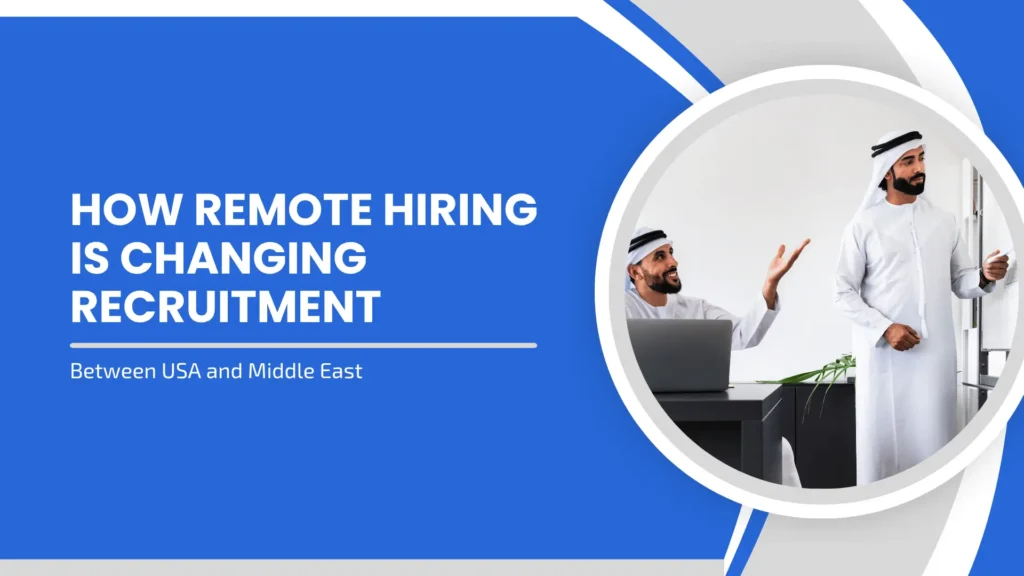
Let’s be real for a second. Three years ago, if you’d told a hiring manager in Dubai they could build a team with senior talent sitting in Chicago, Detroit, or Houstonwithout anyone packing shipping containers you might have gotten a polite smile and a quick subject change.
Now? That conversation happens daily.
The way companies hire between the United States and the Middle East has flipped inside out. Remote hiring didn’t just creep into international recruitment. It kicked the door open. And for Arab American professionals, US employers eyeing GCC markets, and Gulf-based businesses scaling up, this shift is creating opportunities that didn’t exist a few years ago.
Let’s walk through what’s actually changing, what works, what doesn’t, and how you can make the most of it without losing your mind over time zones or visa paperwork.
Why Remote Hiring Finally Bridged the Atlantic–Gulf Gap
For decades, hiring across this corridor meant relocation or nothing. You either flew someone to Riyadh or flew them to New York. There wasn’t much middle ground.
Then two things happened. First, the pandemic forced every company to realize that yes, people can actually do good work from somewhere else. Second, the GCC region accelerated its economic diversification planssaudi vision 2030 jobs for foreigners, Qatar’s World Cup legacy projects, UAE’s digital economy pushand suddenly the talent demand outpaced local supply.
So employers got creative.
Instead of waiting six months to move a candidate through saudi arabia work visa processing or US green card backlogs, companies started hiring remotely first, then figuring out long-term moves later. That shift changed everything.
What This Looks Like for US Employers Hiring in the GCC
If you’re an American company trying to break into markets like Saudi Arabia or the UAE, you’ve probably realized something uncomfortable: building a team there the old way is expensive and slow.
But remote hiring lets you test the waters differently.
Setting Up Without Fully Committing
You don’t need a dubai free zone setup to hire your first two salespeople in the region. Many businesses are starting with contractors or EOR (Employer of Record) arrangements. They validate the market, build relationships, and thenonce the revenue justifies itmove into full entity setup.
When you’re ready for the real thing, setting up a team in saudi arabia has become more transparent than it was five years ago. The Ministry of Human Resources and Social Development has digitated most processes. But here’s what I couldn’t confirm for every specific business type: processing times vary by industry and company size. Always verify current timelines with a local legal partner before committing.
For business expansion in gcc market comparison, here’s the quick version: UAE is still the fastest for setup (especially in free zones), Saudi offers the largest market opportunity but more regulatory steps, and Qatar has become very business-friendly but has a smaller local talent pool.
The Arab American Professional’s Advantage
Here’s something hiring managers are waking up to. Arab American professionals bring a combination that’s genuinely hard to find: native-level English, cultural fluency in both Western and Arab business settings, and often US citizenship or permanent residency.
That last part matters more than people admit.
For a GCC company hiring remotely, an Arab American candidate in the US doesn’t require qatar recruitment laws or Saudi visa processing to start working. They can begin next week. For a US company trying to serve Gulf clients, that same professional understands the unspoken rules of a meeting in Riyadh or Doha without needing cross-cultural training from scratch.
High-Demand Sectors Right Now
If you’re job hunting across both markets, these areas are hottest:
For the US side: arab tech professionals usa jobs are growing fast, especially in cybersecurity and cloud infrastructure. us healthcare jobs for arab medical professionals remain strongif you’ve completed usmle for arab doctors or hold a nursing license usa, many hospital systems are offering visa sponsorship for healthcare workers directly.
For the GCC side: neom project jobs continue hiring across engineering, logistics, and smart city tech. renewable energy jobs saudi arabia are ramping up under Vision 2030. fintech careers dubai are boomingthe UAE wants to become the region’s digital finance hub. tourism jobs qatar are more stable post-World Cup than many predicted. And megaprojects jobs across the region need project managers, safety officers, and commercial leads.
One growing niche I love: bilingual customer support center arabic english operations. As US companies expand into Gulf markets, they desperately need talent for arabic customer service. Some are even building 24/7 support team structure models that follow the sun from North America to the Gulf.
The Visa Reality Check (Because Someone Has to Say It)
Remote hiring is great, but eventually most people want physical relocation. So let’s be honest about the paperwork.
For an Arab professional moving to the US: the h1b visa for software engineers is the most common path, but it’s a lottery. Not skill-based. Random. That’s frustrating, and I couldn’t confirm any near-term changes to that system. If you’re a healthcare professional, cap-exempt H1B roles at hospitals and universities are a smarter bet.
For working in dubai as an american: the process is straightforward if you have a job offer. Your employer handles the dubai expat salary guide minimums (they vary by free zone), and you’ll need medical tests and Emirates ID processing. The cost of living dubai vs usa comparison usually favors Dubai on safety and tax, but housing has gotten genuinely expensive post-2021.
For saudi arabia work visa processes: expect more documentation, including attested degrees and a police clearance. The american community in uae is larger and more established than in Saudi, though Riyadh’s expat scene is growing fast for careers in middle east for westerners.
Keeping People Once You’ve Hired Them
Here’s where many international hiring efforts fall apart. You find great people. You jump through visa hoops. They arrive. Then six months later, they’re updating their LinkedIn.
Retention across borders isn’t harder than domestic retention. It’s just different.
For Employers in the GCC
Expat retention dubai and across the region comes down to three things: onboarding, family support, and growth paths.
Onboarding expatriates in middle east needs to start before they land. Not just HR paperworkreal help with finding housing, school options for kids, bank accounts, and SIM cards. Small stuff kills morale fast when you’re 7,000 miles from home.
Family support uae matters enormously. A sponsored employee whose spouse is miserable will not stay long. Help with spousal employment, community groups, and even just explaining how the local healthcare system works goes further than you think.
Relocation support middle east packages should include at least two weeks of temporary housing and a settlement allowance. The companies that cheap out on this spend triple on replacing people within 18 months.
For Employers in the US
Arab professionals relocating to the US face reverse culture shock, especially around usa tech relocation logistics. Healthcare confusion, public transit differences, and social isolation are real challenges. Networking for arab professionals in usa through groups like ACCESS or local Arab American chambers makes a huge difference in retention.
Cross-cultural training shouldn’t be a one-hour webinar. Good programs cover communication styles (direct vs. indirect feedback), religious accommodations, and practical legal rights. Managers often don’t realize how much small gestures matterlike knowing when Ramadan falls and adjusting meeting schedules accordingly.
Managing Remote Teams Across Time Zones
Here’s my slightly opinionated take. Most time zone problems aren’t technical. They’re egotistical.
A managing remote teams in different time zones strategy fails when one side expects the other to always adapt. The teams that work well have a simple rule: rotate meeting times, respect deep work hours, and over-communicate about availability.
For us arab joint venture project management, the biggest friction point isn’t the 7-10 hour time difference. It’s assumed understanding. Americans tend to be more direct. GCC colleagues may communicate more relationally. Neither is wrong. But both need explicit cross-cultural communication in business training to avoid “why are they being rude?” and “why are they being vague?” conversations.
Practical fix: create a team charter that spells out response time expectations, meeting etiquette, and how to flag blockers. Write it down. Review it quarterly. It sounds basic because it isand that’s why most teams skip it.
Frequently Asked Questions
How can businesses set up a team in Saudi Arabia or Dubai without losing their minds?
Start with an Employer of Record if you need less than 10 people. It’s faster and less capital-intensive. For larger teams, Dubai free zones (like DMCC or DIFC) offer the simplest entity setup. Saudi Arabia requires a local partner for most activities unless you qualify for 100% foreign ownership, which is possible now in specific sectors under recent reforms. Always verify current ownership rules with a lawyerthey change frequently.
What are the requirements for Arab professionals to work in the US or GCC?
For the US: employer-sponsored visa (H1B for tech/professional roles, or cap-exempt H1B for healthcare and research). For the GCC: a job offer is the starting point. The employer handles the saudi arabia work visa or UAE residence permit. You’ll need attested degrees, medical clearance, and a clean background check. The whole process typically takes 2-4 months.
How can expatriates integrate smoothly and stay long-term in the Middle East?
Learn some Arabic phrasesnot for work, for daily life. Build community outside your office (sports clubs, hobby groups, religious communities). Understand that the first six months are the hardest emotionally. People who push through that adjustment period usually stay for years. Also: sort your housing and kids’ schools before you arrive. That uncertainty eats more happiness than anything else.
Which sectors offer the strongest opportunities in 2024 and beyond?
Tech (especially fintech, cybersecurity, and cloud), healthcare (nursing, specialized medicine, health tech), renewable energy (solar, hydrogen, grid modernization), tourism and hospitality (especially in Saudi and Qatar), and anything related to gcc economic diversificationlogistics, advanced manufacturing, and future skills in arabian gulf like AI and data science. Neom careers 2024 continue growing, though hiring timelines can be slower than advertised.
Let’s Get You Moving
Here’s the bottom line. Remote hiring hasn’t killed international relocation. It just made it smarter. You can now build relationships, prove value, and then move peopleinstead of guessing and shipping.
Whether you’re an employer trying to tap Gulf talent or an Arab American professional weighing a move to Riyadh, Dubai, or Doha, the path has never been clearer. Or more flexible.
At Arab American Recruiters, we’ve spent years helping professionals and companies navigate exactly this terrainfrom ksa recruitment to uae talent pool matching, from expatriate onboarding to full international hiring projects. We know the visa pathways, the cultural landmines, and the shortcuts that actually work.