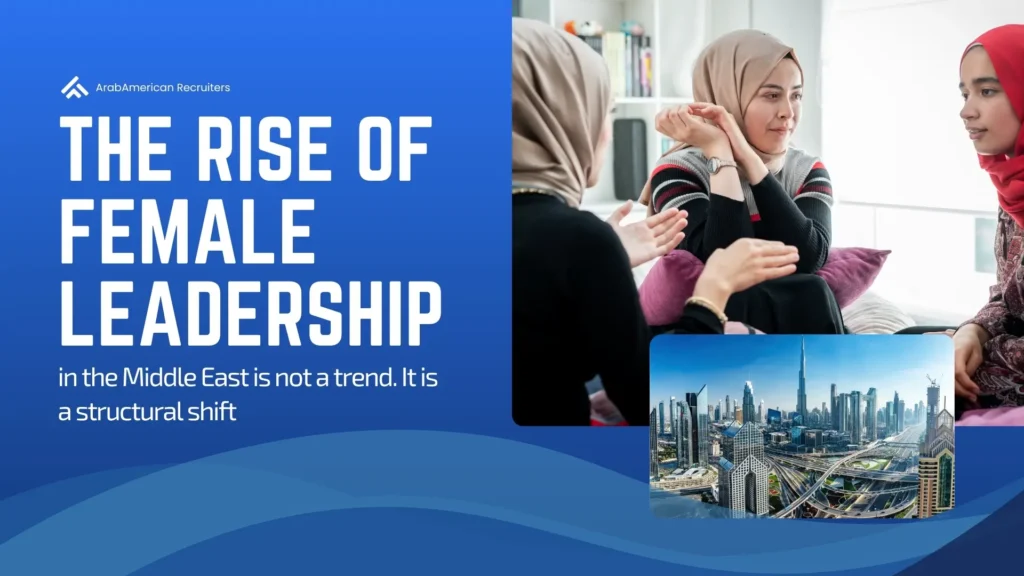
If you have worked with teams in Saudi Arabia, the UAE, or Qatar in the last five years, you have probably noticed something important. Women are no longer being added to leadership conversations as an afterthought. They are shaping strategy, running departments, launching startups, and leading regional expansion in very visible ways.
This shift matters for Arab American professionals considering global careers, for US employers hiring internationally, and for GCC businesses building future ready teams. Female leadership in the Middle East is closely tied to workforce mobility, economic diversification, and how companies compete for talent across borders.
At the same time, progress is uneven. Opportunities are expanding faster than systems, policies, and mindsets can always keep up. That tension creates real challenges for employers and professionals alike.
Let’s talk honestly about what is changing, where the gaps remain, and how organizations and individuals can navigate this moment with clarity.
Why female leadership is accelerating across the GCC
In Saudi Arabia, Vision 2030 reshaped labor participation priorities. Women are now visible in sectors that were historically male dominated, including technology, finance, renewable energy, and large scale development projects. Hiring in Riyadh today looks very different from even a decade ago, especially at the mid and senior management level.
The rise of women in leadership roles across Saudi Arabia, the UAE, and Qatar did not happen by accident. It is connected to long term economic goals and global competitiveness.
The UAE has long positioned itself as an international talent hub. Dubai free zone setup models made it easier for women to launch companies, lead regional offices, and manage multinational teams. The UAE talent pool now includes female executives from across the Arab world, Europe, Asia, and North America.
Qatar’s recruitment environment has evolved alongside its investments in tourism, infrastructure, and international education. While qatar recruitment laws remain structured, employers increasingly recognize that diverse leadership teams improve global credibility and operational resilience.
What ties these markets together is a broader GCC business climate focused on diversification, innovation, and global alignment. Female leadership supports all three.
Where opportunity is strongest for women leaders
Not all sectors move at the same pace. Some industries are actively pulling women into leadership roles because growth demands it.
Technology and digital services are a major entry point. Women are leading product teams, regional sales operations, and engineering management roles, particularly in fintech careers Dubai and enterprise software expansion across the Gulf.
Healthcare is another area of momentum. Women leaders play key roles in hospital administration, clinical operations, and workforce planning, especially as systems scale to serve growing populations.
Renewable energy jobs Saudi Arabia are opening leadership pathways tied to sustainability goals and international partnerships. Large projects require cross cultural communication and long term talent planning, areas where many women leaders excel.
Tourism and hospitality, including tourism jobs Qatar, rely heavily on multilingual teams and service innovation. Female leaders are increasingly visible in regional strategy and operations.
Even megaprojects jobs linked to large scale development initiatives now include women in planning, procurement, and stakeholder management roles.
The leadership challenges that still exist
Progress does not mean the path is smooth.
One challenge is perception gaps. Female leaders are often expected to overperform to gain the same credibility as male peers, especially in traditional environments.
Another issue is uneven policy execution. While regulations may support inclusion, day to day workplace practices do not always align. This is where strong internal leadership and cross cultural training matter.
Mobility can also be complex. For expatriate women, relocation support Middle East programs are not always designed with family or long term integration in mind. Family support UAE policies vary widely by employer, and inconsistent support impacts retention.
Remote and hybrid leadership adds another layer. Managing remote teams in different time zones requires clarity, trust, and communication discipline. Women leaders often shoulder more coordination labor, which is not always formally recognized.
None of these challenges are insurmountable, but they require intentional planning rather than assumptions.
What this means for employers building teams in the Gulf
If you are setting up operations or scaling in the GCC, female leadership should be part of your workforce strategy, not a side goal.
When setting up a team in Saudi Arabia, consider leadership pipelines early. Identify roles where local and expatriate women can grow into decision making positions. Align this with compliance requirements and saudi arabia work visa processes so mobility does not become a bottleneck.
Ksa recruitment strategies that rely solely on traditional networks risk missing high potential female candidates. Broaden sourcing channels and invest in structured interviews that reduce bias.
In the UAE, especially during Dubai free zone setup, companies have flexibility to design inclusive governance models from day one. Use that advantage. It helps with expat retention Dubai and strengthens employer brand perception.
In Qatar, clarity is key. Understanding qatar recruitment laws and pairing them with transparent onboarding expatriates in middle east processes improves trust and retention.
Across all markets, cross cultural training is not optional. It supports female leaders navigating diverse teams and helps managers understand different leadership styles without defaulting to stereotypes.
Retaining female expatriate leaders long term
Hiring women into leadership roles is only the first step. Retention is where many organizations struggle.
Expatriate leaders often leave not because of the role, but because of lifestyle friction. Spousal employment support, school access, healthcare clarity, and community integration all matter.
Providing structured relocation support Middle East programs shows commitment. So does flexibility around travel, remote work windows, and leadership development planning.
Clear career progression also matters. Women want to know whether their role is a stepping stone or a ceiling. Honest conversations build loyalty.
Career pathways for Arab women professionals globally
The rise of female leadership in the Middle East also connects to career mobility between the GCC and the United States.
Arab American professionals increasingly move between markets, bringing regional expertise to US companies and global exposure back to the Gulf.
In the US, arab tech professionals usa jobs remain in demand, particularly in software, data, and product management. For those exploring the h1b visa for software engineers, employer readiness and timing are critical.
Healthcare offers another pathway. US healthcare jobs for arab medical professionals require licensing and credential planning, including usmle for arab doctors and nursing license usa processes. These are long term investments but open stable leadership tracks.
For women who later return to the GCC, this international experience strengthens credibility and accelerates leadership placement.
Organizations like Arab American Recruiters have worked on both sides of this equation, supporting international hiring projects and expatriate onboarding across the US and GCC. Their experience reflects how interconnected these talent flows have become.
Leadership is also about managing across cultures and time zones
Modern leadership in the Middle East is rarely local only.
Women leaders often manage distributed teams across Europe, Asia, and North America. Managing remote teams in different time zones requires strong systems, not constant availability.
Clear documentation, defined decision authority, and respect for local working hours protect leaders from burnout. Companies that fail here often lose high performing women first.
Cross cultural communication in business is not about soft skills alone. It directly impacts execution speed, trust, and retention.
Industry questions people ask all the time
How can businesses set up a team in Saudi Arabia or Dubai?
Start with clarity on your legal structure and hiring timeline. Align leadership roles early, understand visa pathways, and invest in onboarding processes that support diverse leadership styles from day one.
What are the requirements for Arab professionals to work in the US or GCC?
Requirements vary by country and role. In the GCC, work visas are employer sponsored. In the US, options include H1B for tech roles and licensed pathways for healthcare professionals. Always verify eligibility early to avoid delays.
How can expatriates integrate smoothly and stay long term in the Middle East?
Integration improves with structured onboarding, family support, cultural orientation, and clear career progression. Employers play a major role in whether relocation becomes sustainable.
Which sectors offer the strongest opportunities in 2024?
Technology, healthcare, renewable energy, fintech, tourism, and large development projects continue to lead. Leadership opportunities grow fastest where skills shortages meet expansion goals.
Why this moment matters
Female leadership in the Middle East is not just about representation. It is about how organizations compete, how talent moves globally, and how future economies are built.
For employers, ignoring this shift limits growth. For professionals, understanding it opens doors that did not exist before.
The opportunity is real, but it rewards preparation, cultural awareness, and long term thinking.
A final word for employers and professionals navigating this space
If you are building teams, expanding internationally, or planning your next career move across the US and GCC, pay attention to how leadership expectations are evolving. The rules are changing, and those who adapt thoughtfully will lead the next phase of growth.
If you want grounded insights on international hiring, expatriate onboarding, and placing Arab professionals across US and GCC markets, you can explore resources from Arab American Recruiters at Arab American Recruiters.